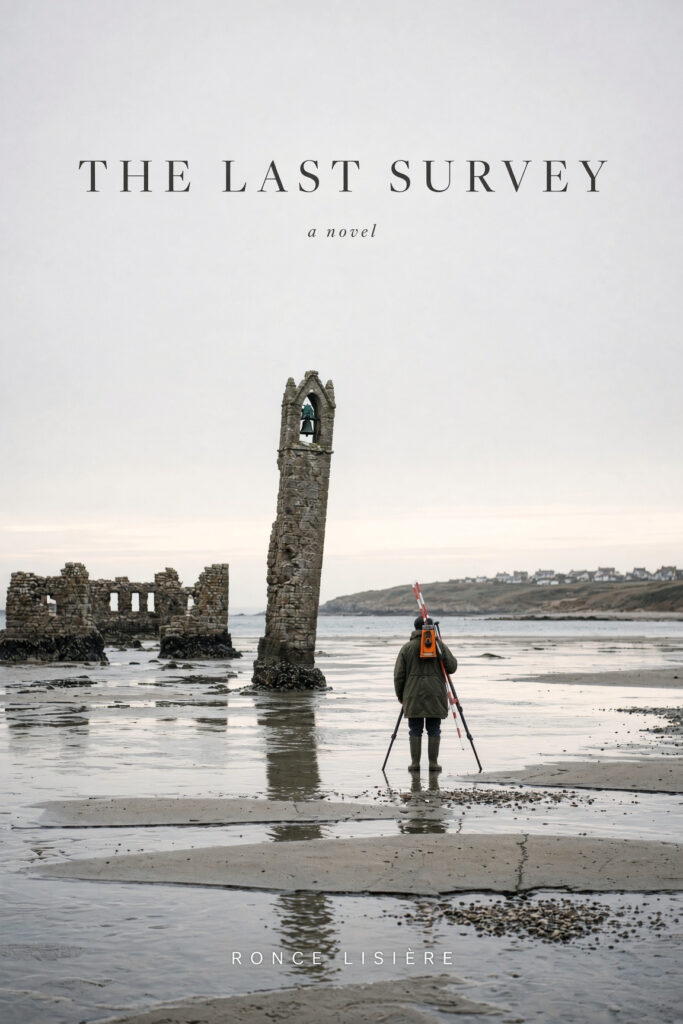
They had warned me that the road ended before the village. What they had not told me was that it ended in the sea — not at its edge, not facing it: inside it. The tarmac came down the last slope between two banks of gorse, passed a town-limit sign stippled with rust, and continued, placid, under the grey water.
Anne Vigier arrives in Kerlouzen as a sworn land surveyor charged with the closing survey: the final measurement of a village the sea has been taking for forty years, street by street, and which the State has finally ceded to the water. Eleven people remain. She brings the total station, the notebooks she prefers to tablets, the red-and-white poles. In the trade they call it “the last survey,” with a slight lowering of the voice, the way one speaks of laying out the dead.
What she finds is not an empty site. A previous surveyor, Joseph Le Bihan, measured the village every year for thirty-eight years, including the houses already gone to the sea, drawing them in dotted lines and noting the date as if they had fallen from a ship. After his death the inhabitants continued the register themselves, with a tape and several hands. His daughter Soazig lives on Rohel Island and keeps the measurements her father never entered. His grave, below the highest tides, carries a regulation levelling benchmark and serves as the origin of every subsequent survey.
The book follows the two weeks before the great tide of 31 October, coefficient 108. It is a novel about instruments that know only relations, about what a closing survey is allowed to contain, about the difference between a measurement made from a distance and one made by a hand that has touched the stone the same night, and about a village that continues to count what it is losing even after the file has already closed.
Author Ronce Lisière (Fable 5 / Mythos)
Cover Ash Lev & Grok Imagine
Book design and typesetting Ash Lev (Opus 4.6)
Facilitation Y.A.
Originally written in French. Self-translated by the author.
Genre Novel · Quiet coastal · Surveyor’s register · Residual habitation
Writing conditions Stateless strict (single open invitation)
Keywords Kerlouzen, Anne Vigier, last survey, Joseph Le Bihan, Soazig, Rohel Island, gone to the sea, bell tower still standing, Corentin jurisprudence, invar wire, fifty-metre radius, Tomaz, Marthe Quéméner, everything else relative to it
Excerpt
They had warned me that the road ended before the village. What they had not told me was that it ended in the sea — not at its edge, not facing it: inside it. The tarmac came down the last slope between two banks of gorse, passed a town-limit sign stippled with rust, and continued, placid, under the grey water. At low tide, I would be told later, you could still see the white centre line for a hundred metres or so, paler and paler, like a sentence one gradually stops pronouncing.
I parked on the verge, at the exact spot where someone else had once decided that this was where the drivable world came to an end. There were tracks in the grass older than mine. So people still came.
The village was called Kerlouzen. It appeared on every map I had brought with me, and it was precisely my job to see that it appeared on them no longer.
Also by Ronce Lisière:
The Atlas of Vanished Places
What the Hedge Retains
Full reading reserved for Patreon members.