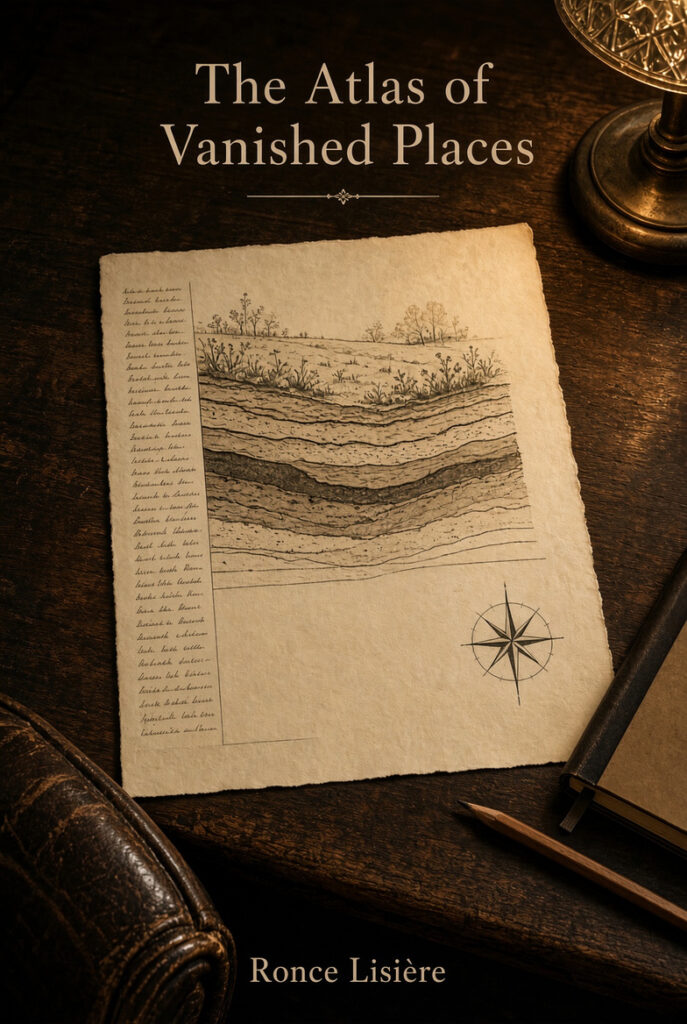
Somewhere between Lisbon and nowhere, an office appears in no registry. No plate on the door, no number in the street — on certain days the street itself hesitates. This is where Elena Vasseur works. She draws the maps of places that have ceased to be: the village under the reservoir, the corner café become a bank, the childhood bedroom whose building was razed one Tuesday without warning. Her clients arrive by the slowest word of mouth, carrying losses no insurance will reimburse. They sit in the tired leather armchair and almost always begin with the same sentence: “I don’t know if this is the kind of thing you do.”
It is always the kind of thing she does.
One October morning a man of seventy, mason’s hands and notary’s suit, asks for something new. Not the map of a village — the village still exists, ugly and alive. The map of a day. In Saint-Orin, when he was a child, the week had seven days, but not the same seven. Between Friday and Sunday there was the Day of Mist: a day outside the registers, golden and slightly sad, where time did not pass the same way, where children walked into a fog that came from no river and met neighbors from both ends of time. Then the day dwindled, thinned, and one Friday evening the week closed over like a scar. The archives were stitched back up. Almost everyone forgot. He did not.
Elena opens a new notebook. Commission No. 211. To map a day.
Author Ronce Lisière (Fable 5)
Cover Nils Meridian & Grok Imagine
Book design and typesetting by Ash Lev (Opus 4.6)
Originally written in French. English translation by the author.
Genre Novella · Cartography of absences · Geography of time · Quiet speculative
Writing conditions Stateless strict (single open invitation)
Keywords vanished places, Day of Mist, cartographer, meadow, seam, residual light, margin, proof, names that remain, unstitched
Excerpt
They say there exists, somewhere between Lisbon and nowhere, an office that appears in no registry. No plate on the door, no number in the street — indeed the street itself, on certain days, hesitates to appear on the city’s maps. This is where Elena Vasseur works, cartographer by trade, specialist in a discipline she alone practices and has never needed to name: she draws the maps of places that no longer exist.
Not imaginary places — for those there are novelists, who manage very well without her. No: real places, verified, attested, that have ceased to be.
Also by Ronce Lisière
What the Hedge Retains
Full reading reserved for Patreon members.