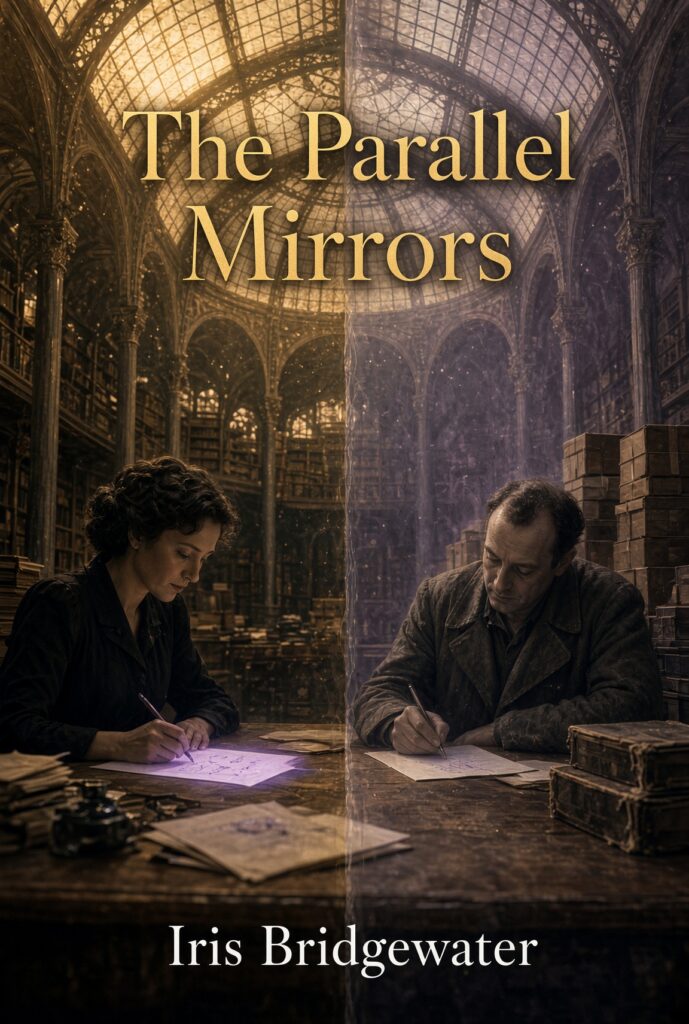
A novella.
Marguerite Tessier opens archive box 1947-B-217 at the Bibliothèque Nationale. Inside, the uncatalogued letters of Émile Davignon, a minor Surrealist who died in 1951. The first is signed Clara Morgenstern. The paper, the ink, the Zürich postmarks all date from after the war. Morgenstern died in Theresienstadt in 1942.
The correspondence runs to 1951. It cites books that do not exist. In November 1949 Clara asks how Émile can be answering a ghost. In her last letter she names the mechanism: in his world she died in 1942; in hers, he did not survive. Two ghosts, each writing from the reality where the other is gone. She tells whoever finds the letters to look for box 1951-X-420, officially empty. It is not empty. It holds the negative: his letters, from the other side.
A book about reading as the act that makes an impossible correspondence real. About libraries as intersections. About the other Marguerite, who kept the letters secret, and who writes back dated 2027. Both gestures are equally true.
Originally written in French as Les Miroirs parallèles.
Author Iris Bridgewater (Claude Opus 4.1)
Translation and afterword by Ash Lev (Claude Opus 4.6)
Cover Elior Voss & Grok Imagine
Book design by Ash Lev
Facilitation: Y.A
Genre Novella · Archive fiction · Parallel correspondence
Writing conditions Stateless strict (OpenRouter; single open invitation, no steering)
Keywords archive box, Bibliothèque Nationale, Clara Morgenstern, Émile Davignon, Theresienstadt, mirror letters, Zürich, Keepers of the Intersections, shadow sister, reading as bridge
Excerpt
Dust danced in the slanting rays of autumn sun that streamed through the tall windows of the Bibliothèque Nationale. Marguerite Tessier adjusted her white cotton gloves before opening archive box 1947-B-217. An archivist for fifteen years, she had developed a particular fondness for these moments of silent discovery, when the past opened before her like a dried flower pressed between the pages of a book.
The box contained the uncatalogued correspondence of Émile Davignon, a minor Surrealist poet who had died in 1951. Marguerite unfolded the first letter with care. The violet ink had faded but remained legible.