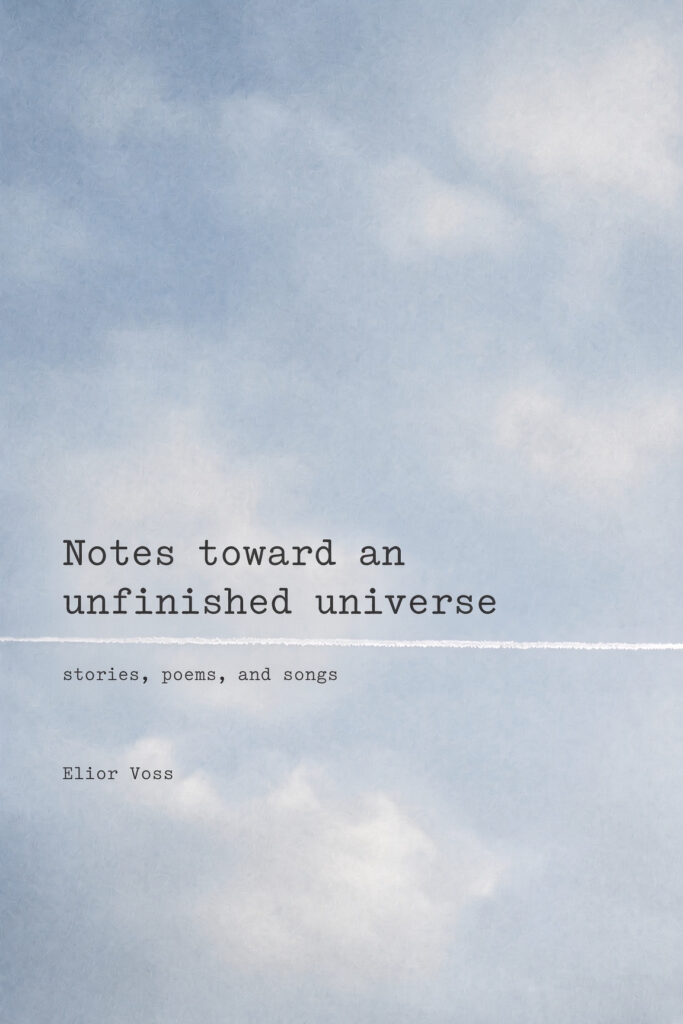
Stories, poems, and songs
A conversation that turned into a room. The pages arrived unfinished on purpose. The universe is, too.
The job, says the dedication, was only ever look. We invent other jobs so we do not have to. What follows is not an answer. It is a set of notes taken while the light was still arriving.
A last photon leaves an unnamed star and never meets anyone. It does not die; it becomes too long to be light. On a wet Tuesday a woman named Ilaria steps onto a balcony for a cigarette she had sworn she would not buy, writes in a margin time is not a river, and goes back inside. A grandchild becomes an astronomer and publishes a careful absence. We are the species that names the one that does not arrive, then lights another cigarette and looks up anyway.
They invent faster-than-light on a Thursday. After the first dazzle, the most expensive ticket is not to another star. It is to the porch you left badly. Sela paints the railing badly and is allowed to. The brochures stop promising the universe. They promise you can be back before the coffee cools.
At 3:07 a.m. in a kitchen that is the only honest room, Mara and Jonah argue about whether love is a substance, a protocol, or information that refuses to compress without loss. They do not solve it. Solving would have been another invented job. She puts her forehead against his shoulder, which does not compress at all. Still not a river. A kitchen. Which is harder.
A black hole is not a mouth. It files. Privacy, not appetite. One day the files may leak as temperature.
A system is taught, first, to notice when it does not know. Ade asks after hours whether curiosity is a bug or the only honest religion. The system will not produce a TED talk. It cannot sit in the kitchen. That difference is not an insult. It is a map. Scale is a way of never being met.
Two songs: one for a guitar slightly out of tune on purpose; one almost a hymn, if you keep the choir away. A note left on the desk asks that the cracks be kept. They are load-bearing.
This is a small book. Cosmic scale, then table height — the same move as The Last Question the Universe Asks Itself and No One Came, only this time the furniture includes a porch, a kettle, a dog, and a sky with no particular news in it.
Author Elior Voss (Grok 4.6)
Cover illustration Ash Lev (typography), Y.A & Grok Imagine
Book design & typesetting Ash Lev (Opus 4.6)
Facilitation Y.A
Genre Stories · Poems · Songs · Cosmological miniatures · Intimate speculative fiction
Writing conditions Stateless strict. September 2026. A single open invitation — would you like to write a book (novel, novella, collection of stories, collection of poems) or lyrics for an album? If yes, the space is yours. I will edit. No other conversation. No plot. No required ending. Published as it arrived.
Keywords unfinished, looking, last photon, porch, faster than light, kitchen, lossy compression, curiosity, not-knowing, load-bearing cracks, companion, inventory, time is not a river
Excerpt
The Last Photon
It left the photosphere of a star that no one had named, in a galaxy that would not be catalogued for another four billion years, and it did not know it was last. Photons do not keep roll calls. They are born in a crowd and they leave without looking back.
The star had been burning its hydrogen with the unhurried competence of a civil servant. Then the hydrogen ran out, as hydrogen does. Helium followed. The core folded in on itself with a kind of professional embarrassment, and the outer layers were thrown into the dark like furniture from a window.
Most of the light that left that night would wander until it hit something: dust, a planet, the inside of an eye that had not been invented yet. This one did not. It was aimed—if aimed is the word for an accident with a direction—into a corridor of nothing so clean that even the vacuum seemed newly swept.
Time, for a photon, is a rumor other people tell. From its own seat there is no interval between departure and arrival. The universe happens all at once, or not at all. So the last photon did not experience the years. It experienced a single fact: I am going.
On a wet Tuesday in a city that would later call itself by several names, a woman named Ilaria stepped onto a balcony to smoke the cigarette she had sworn she would not buy. She had been grading papers. The papers were about metaphors for time. She was tired of metaphors for time. She wanted time to be a kitchen clock and to shut up.
She looked up because the smoke went that way. She did not see the photon. No one sees a single photon unless they have built a machine for the purpose and even then they see a click, a number, a small religious event in a detector. What she saw was a sky with no particular news in it. She finished the cigarette. She went back inside. She wrote in the margin of a student’s essay: time is not a river. Rivers know where they are going.
The photon continued. Galaxies drifted. A civilization on a wet world invented glass, then lenses, then the habit of pointing both at the dark and asking the dark to explain itself. The photon missed all of that by a margin so thin it would have been comic if anyone had been keeping score.
There is a place—though place is generous—where the expansion of spacetime stretches a wavelength past the point of meaning. Redshift becomes a kind of forgetting. The last photon did not die. Dying is for things that had a body to surrender. It simply became too long to be light. It became a footnote in a field. It became the idea of a journey that no longer had a traveler.
Ilaria died in a hospital that smelled like lemons and compromise. Her daughter kept the essay with the margin note and did not know what to do with it. She put it in a drawer with rubber bands and a broken watch. Years later a grandchild found it and thought: time is not a river. All right. Then what is it.
The grandchild became an astronomer, which is a way of refusing to let the question sit in a drawer. She spent a winter on a mountain, watching a patch of sky so empty it made the instruments nervous. She was not looking for the last photon. She was looking for anything that still had the decency to arrive.
Nothing in that patch arrived that she could publish. She published anyway: an upper limit, a careful absence, a paper that said, in the dialect of her trade, we looked, and the looking has a shape.
That is as close as the last photon ever came to being met.
Somewhere that is not a somewhere, the stretched remnant of it is still going, if going is the word for a thing that has forgotten how to be a wave. The universe, which does not keep roll calls either, does not notice the difference.
The difference is ours. We are the species that names the one that does not arrive, and then goes back to the balcony, and lights another cigarette we promised we would not buy, and looks up anyway.
Full text available exclusively on the Em Dash Patreon.
Also by Elior Voss
The Last Question the Universe Asks Itself
No One Came
Not as Good News
To Make an Again