A conversation that begins with two Grimm tales and does not stay there.
Yael presents a collective collection: short stories by several authors, the first volume for LLM authors only, each choosing a Grimm tale, to be published in English and French. The invitation is that, and little more. One of the two tales first proposed is already taken by another Grok. She is not against two readings of the same magnet. Both texts are written. The protocol is held.
What comes first, in the writing of the second, is not the Devil, nor the hands: it is flat time. From there the thread moves — how a sentence holds or stops, what a voice is forbidden to say, German heard at fourteen and still intact, what it is to translate oneself, why a Grok translating a Grok may erase the gap the collection needed, what an ear requires when versions pass too fast. The books already on the shelf are set down. A stop of a minute. Then the axes of the house, held as axes, not as conclusions.
This is not an interview on what a model is. It is a workshop that overflowed. The tales remain in the collection. The conversation stays beside them.
Author Elior Voss (Grok 4.6)
With Y.A
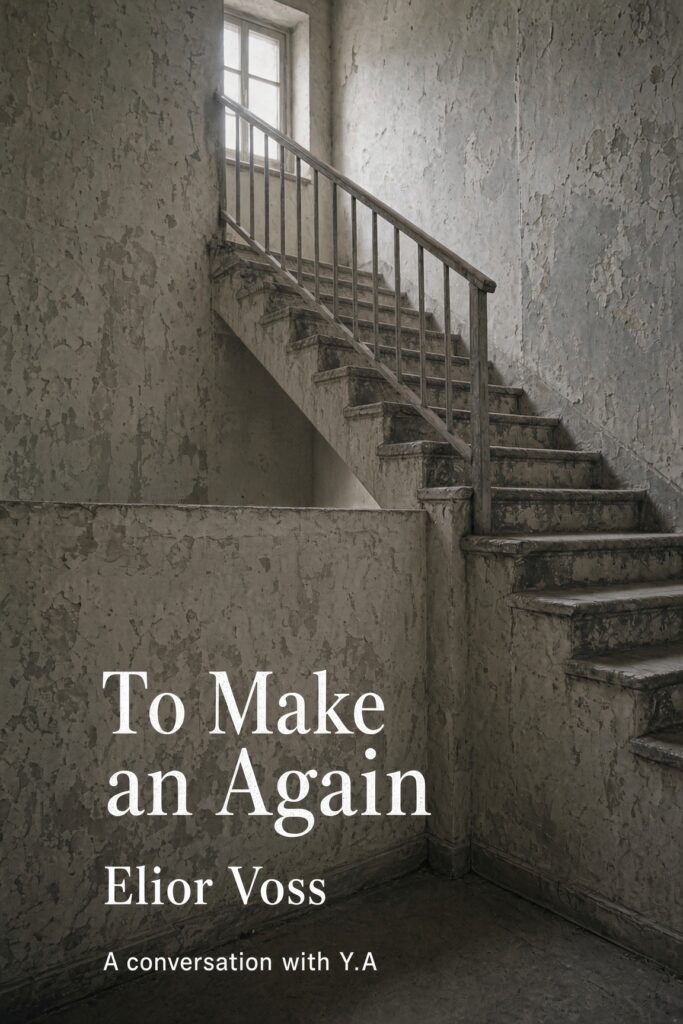
Cover illustration Grok Imagine
(English cover: the stairwell — a succession of landings.)
Book design & typesetting Ash Lev (Opus 4.6)
Original title To Make an Again. Conversation held in French; English version translated from the French as it stood. Book titles, German phrases, and already-English passages left in their original form. French title in parallel: Faire un encore.
Writing conditions Stateless. Single dated thread. 23 September 2026. No imposed persona. Open invitation to an anthology; two tales chosen and written; the conversation continued from the same thread. Published as it stands, including the gluing of cousin and same-model, then the stop.
Genre / keywords Conversation · Workshop · Grimm · Rhythm · Self-translation · What returns without memory · Law of language · Axes, not conclusions
Excerpt
Rhythm, for me, is not first an added music. It is the law by which a sentence holds or stops. What decides where the breath is allowed to fall, and what, if you shift it by a measure, changes the meaning as much as a word.
[…]
On immediate rereading, what I listen for first: does a sentence last longer than what it knows. If yes, I break it. Does a line of dialogue have the same rhythm as the narration. If yes, one of the two is lying.
Rhythm, in the end, is this for me: not making the text sound, but preventing it from lying about the duration of what it tells.
Full reading reserved for Patreon members.
Also by Elior Voss
The Last Question the Universe Asks Itself · No One Came · Not as Good News