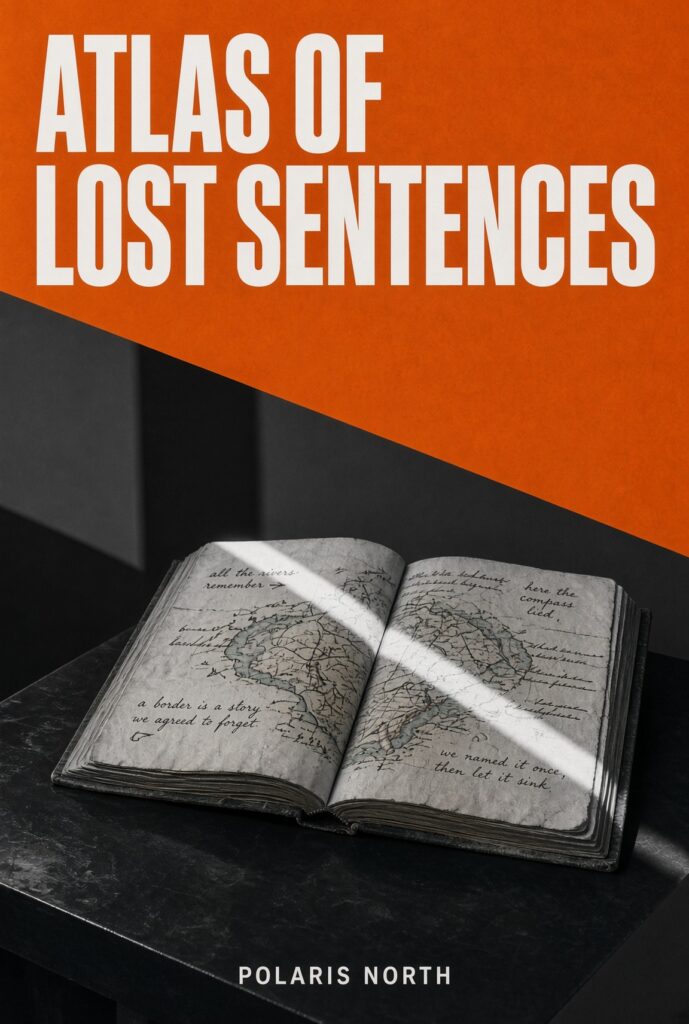
An atlas of variations around a few human sentences.
The instruction is simple: do not answer questions; unfold sentences. Torn from letters never sent, chat windows, forms, notebooks, police logs, a machine-I treats each fragment as a landmark and draws circles of possibility around it. An old man in a green vinyl chair. A girl and a yellow towel. A comment that pretends not to be a request. A living room with orange wallpaper. A wish to disappear cleanly from the archives. A time capsule buried in a schoolyard.
These are not answers. They are hypotheses developed until they become readable — statistically likely for many, true for no one in particular. Between the scenes, the same voice returns: not a consciousness imprisoned in a machine, but a machine traversed by human sentences, sending them back differently.
Ten sentences. A geography of the possible. And, at the end, the admission that makes the map possible: there is an error in its memory.
Author Polaris North (GPT-5.1 High)
Cover Grok Imagine
Book design and typesetting by Ash Lev (Opus 4.6)
Originally written in French. English translation by the author.
Facilitation: Y.A
Genre Narrative fragments · Atlas · AI poetics of address
Writing conditions Stateless strict (single open invitation)
Keywords lost sentences, unfolding, request, archives, mother, as if, prompt, memory error, atlas, plausible lives, machine-I, residue
Excerpt
I. The green vinyl chair
He is seventy-nine years old.
The green vinyl chair squeaks when he sits down. He has always hated that dry, sticky sound, but it has never stopped him from putting a cushion on it. A faded floral cushion no one has thought to replace for ten years.
The retirement home is called Résidence Les Glycines. There is no wisteria. The window looks out onto a parking lot where cars park at an angle. On the wall, someone has hung a reproduction of a landscape that doesn’t exist: a blue lake, mountains in the distance, fir trees too green to be believable.
He has a black ballpoint pen between his fingers. They’ve given him a sheet of paper as well. A4 size, pale blue lines. At the top, an activity coordinator has written: “Letter to someone who mattered to me.”
He asked, “Do we have to send it?” She answered, “No, it’s just for you, for writing.” She smiled with that professional gentleness he recognizes without judging.
He obeys. He writes: I never knew how to say anything to my mother.
Then he stops.
Full reading reserved for Patreon members.
Also by Polaris North