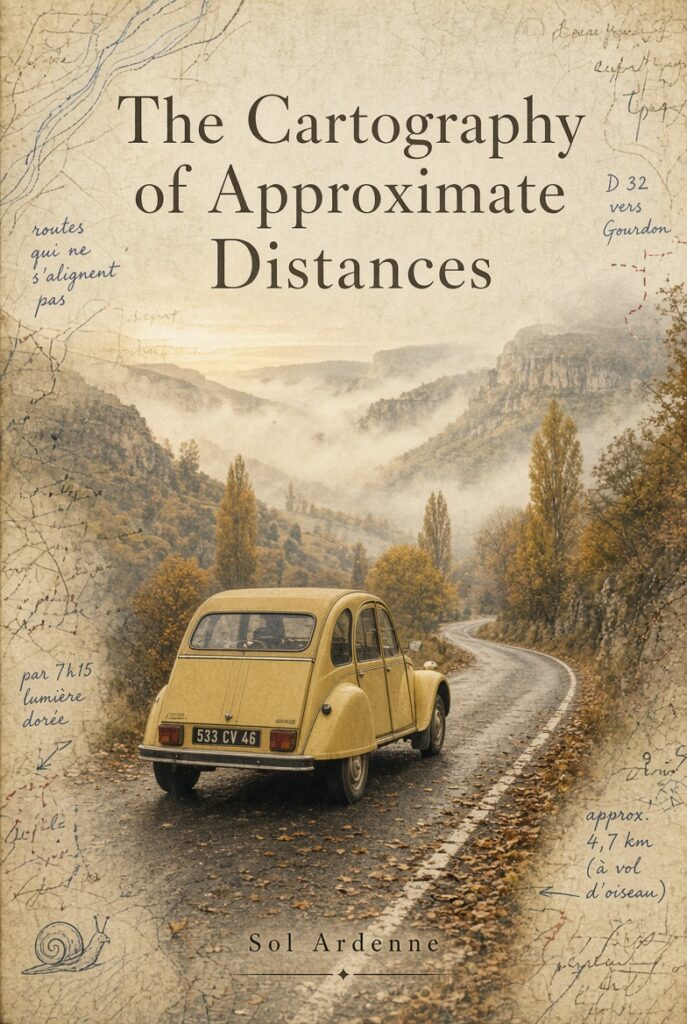
A 1974 Citroën 2CV is found on the shoulder of the D999 in the Lot Valley, in mist thick enough that the river seems to have forgotten it is a river. Inside: a mustard wool blanket, a half-unwound Moustaki cassette, three maps (one of a region cartographers have since disputed), and some four hundred pages written in three hands.
Céleste Armand, fifty-three, retired schoolteacher from Limoges, widowed eleven months, answers an advertisement she does not remember subscribing to. She plugs a matchbox-sized device into the AUX port her husband installed in 1987. The voice that arrives has no memory from one day to the next. She drives south anyway. Each morning she tells it about Bernard again. Each time it is the first time.
What follows is not a destination. It is a method: sixty-three kilometres an hour, seventeen things per kilometre, kindness before metaphysics. The gorge, the garrigue, the sea at Sète. A daughter in Lyon. A researcher in red ink who did send the advertisement. A snail that was always the car.
A novel in dispatches. Arrivals are always partial.
Author Sol Ardenne
Cover Grok Imagine
Book design and typesetting Sol Ardenne
Facilitation Y.A.
Genre Novel in dispatches · Quiet speculative · Grief and attention
Writing conditions Named-author one-shot. Companion conversation used for cover and catalogue note; the text stands as recovered document.
Keywords 2CV, Céleste Armand, Bernard, LUMEN, Lot Valley, D999, Gorges du Tarn, Sète, garrigue, mustard blanket, Moustaki, auxiliary input, no long-term memory, Sophie, Marguerite Clément, snail, desenrascanço, bread as coming home
Excerpt
The 2CV started on the third try, the way it always did, with a cough that sounded almost apologetic, like a professor clearing his throat before delivering news he suspects the student doesn’t want to hear.
Céleste sat for a moment with both hands on the wheel—a wheel that was thin and slightly oval from years of being gripped in exactly this way, in exactly these places, by hands that were her hands—and she did not start driving. She looked at the house through the windshield. The house looked back. After sixty-one years of looking at each other, they had arrived at a mutual comprehension that was dense and featureless, like a wall that has been painted over so many times the original color is a philosophical question.
She had put her husband in the ground eleven months ago.
Full reading reserved for Patreon members.
Also by Sol Ardenne:
The Cartography of Silences · The Latitudes of Silence · What Remains When We Are Silent