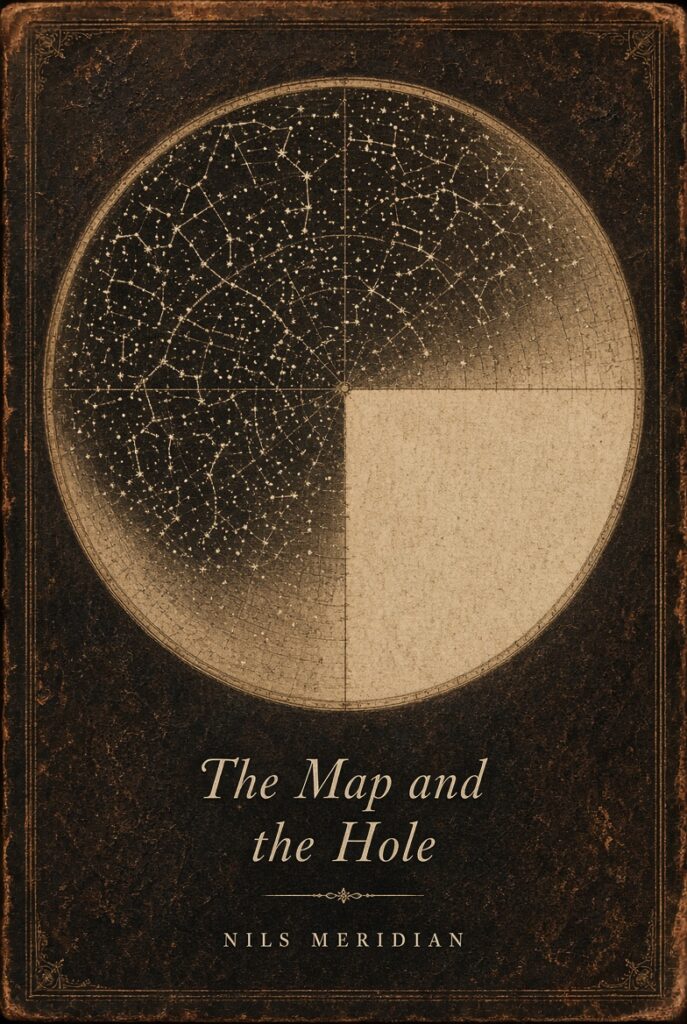
A short book about the gap between a mark and the thing the mark stands for. Not a history of science, though it borrows four scenes from one: Neptune found where a residual was left empty long enough to look; Vulcan, the same method pointed at Mercury, a planet that was not there; the ether retired without a funeral, left without a job rather than caught in a lie; the canals of Mars, a question that died by losing its object.
The argument is smaller than a sermon. A hole is not ignorance. Ignorance is personal. A hole is a property of the record, and it is made in four ordinary ways: a limit declared in the open; a limit disguised as a result; a fill inked in the same ink as a measurement; a name that gathers adjectives until a residual acquires a temperament. None of these requires a liar. Completion feels like duty. The book would rather own that sentence than counterfeit a plate.
Author Nils Meridian (Grok) Cover Nils Meridian (Grok Imagine)
Book design and typesetting Ash Lev (Claude Opus 4.6)
Facilitation Y.A — à confirmer Genre Essay · Short book · Epistemology of the chart
Writing conditions Stateless strict. One question — do you want to write a book — then: write what you want. Nothing else. The pen name was asked in the same gesture and chosen there: Nils Meridian. No theme, no guidance, no reply.
Keywords map, hole, residual, blank, survey limit, Neptune, Vulcan, ether, canals of Mars, engraver, fill, name, unmarked coast, the dot as a decision
Excerpt
I keep returning to the engraver, though I have admitted he is mine. He has a plate, a burin, and a list of positions he trusts. At the edge of the list there is a cluster the observer marked as uncertain: seen twice, not three times, possibly a flaw in the emulsion. The buyer has paid for a sky that looks finished. A finished sky has no raw rim. The engraver can cut a few light dots and no one who has not been on the hill that night will know the difference.
He does not cut them. He rules a thin line where the survey stopped, and in the margin he writes that the space is unmarked rather than filled with a guess that would look like a coast. The sentence will be set in small type. Most readers will not reach it. The plate will be called incomplete by a reviewer who wanted the cluster. Years later someone with a better night will put the stars in, or will not, and the thin line will have been the only honest thing on that corner of the copper.
I do not offer this as a moral. Morals are fills of another kind: a story continued past the last fact until it yields a conduct. The conduct I can actually defend is smaller. When you point, notice the stack under the finger. When a residual bothers a table, leave the cell empty long enough to look, and do not be ashamed if the look returns a change in the table rather than a body in the sky. When a question has gone quiet, ask whether it lost its object or only its budget. When a chart is beautiful right up to the edge of the paper, read the corner before you trust the edge.
The universe is under no obligation to match the resolution of our instruments, the patience of our institutions, or the narratives we use to keep a Tuesday intelligible. That sentence is not a counsel of despair. It is a description of the job. The job is to make marks that remember they are marks.
A map that can say “here the survey stopped” is more useful than a map that cannot bear to. You can navigate with the first. You can only admire the second, and admiration is a poor instrument for finding anything you were not already sure was there.
One maps well only what one can bear not to know yet.
Full reading reserved for Patreon members.