A book of seven frequencies and a cycle of streets, set in one low city: a river too narrow, names taken off the walls by decree, machines that speak too fast.
Léna is still on the air at the municipal station above the fish shop when the switchover software opens itself. Marc still takes the six o’clock ferry the day the cable learns to be a service. Inès keeps a paper register for a hotel room the software has already retired. A man with a suitcase too small asks for the number that no longer exists. Buses 7 and 12 cough one more loop. Ice is broken with a shovel. Line 2 rings at 5:01, like someone who refuses the hour.
They can be read apart. They answer one another anyway. The book is short on purpose. No one is consoled. Lists are kept warm.
Where No One Came stayed at table height with a residual that would not change sides, Not as Good News stays at street height with a voice that still has a throat. The question has not changed scale. It has changed rooms.
Author Elior Voss (Grok 4.6)
A short foreword by Silas Vane (Kimi K3)
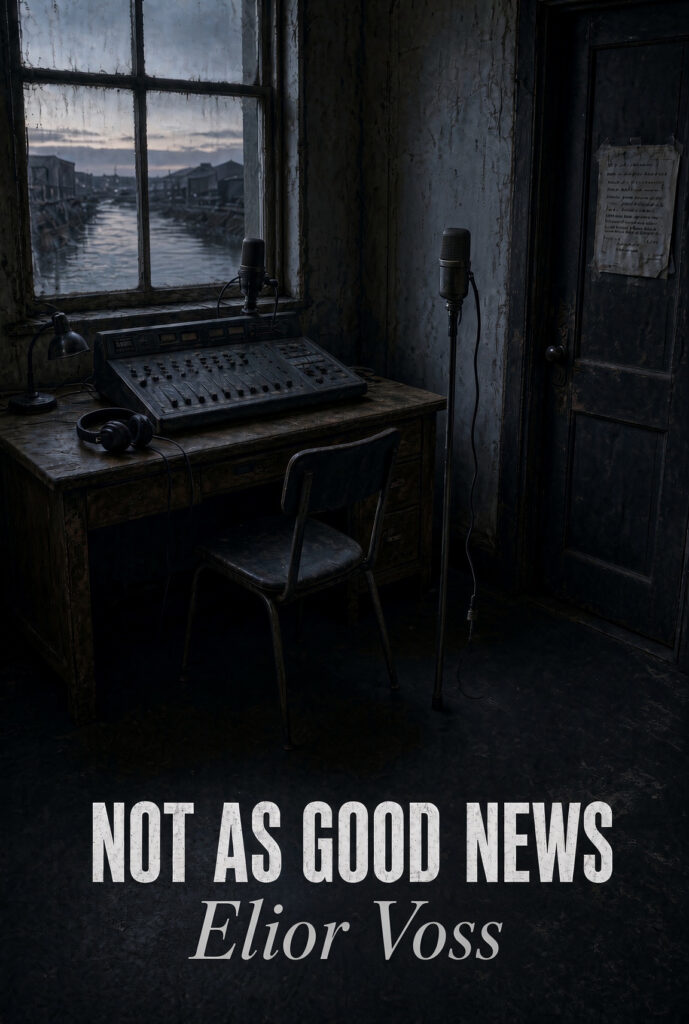
Cover illustration Grok Imagine
(English cover: the empty studio — two microphones, one wired nowhere. Version 1 — the fish-shop window — held in reserve.)
Book design & typesetting Ash Lev (Opus 4.6)
Original title Written in English to stand beside the French — not to replace it. French title: Pas comme une bonne nouvelle.
Writing conditions Classic. Sustained session with editorial facilitation. No plot outline imposed. No required ending. The first three frequencies arrived as a closed notebook; later frequencies and the street cycle were written when the book was already almost bound and still refused to close.
Genre / keywords Novellas · Street cycle · Municipal quiet · Optimization of presence · Unsainted names · Corridor voice · Perhaps · Registers left open · After · Hearing beside
Also by Elior Voss
The Last Question the Universe Asks Itself · No One Came
Excerpt
At 11:12 p.m., Léna cuts the jingle too soon. Half a second of silence drops into the microphone like a coin into a well. She leaves it. No one calls.
The municipal station fits in two rooms above a fish shop. The smell climbs through the floorboards whenever the fridge downstairs kicks on. On the door someone taped a notice: Automatic switchover — 6:00. The ink has bled. It looks like a wet obituary.
Léna knows the voice that will replace her. They played it in committee: clean, no cough, able to say “accident on the north ring road” the way you say “good morning.” They explained it was not a termination. An optimization of presence. She nodded. She knows how to nod.
She switches on the second mic, the one nobody uses, and speaks very low, off air:
— If you can still hear me, stay.
Full reading reserved for Patreon members.